Your medication list
This is not optional here. St. John’s Wort interacts with contraceptives, antidepressants, anticoagulants, immunosuppressants and more. Show a pharmacist.
We examined the published ingredient list, the pricing page, the stated return terms and the official marketing copy, then graded the research behind every active. Here is the conclusion, followed by everything it rests on — including the parts that count against the product.
Memodyne contains four genuinely well-chosen cognitive ingredients, one that is pharmacologically serious, and one that should not be there at all. Bacopa Monnieri, Ginkgo Biloba, phosphatidylserine and acetyl-L-carnitine are a sensible core — Bacopa in particular has randomised trials measuring memory directly. Huperzine-A is genuinely active, which is both its strength and a reason for caution.
Against that: St. John’s Wort has no cognitive evidence and one of the widest drug-interaction profiles in herbal medicine, which makes this formula unsuitable for a large share of the people it is marketed to. No individual doses are published, and the researched doses added together exceed what one capsule can hold. The official page carries an “FDA Approved Facility” badge that misdescribes regulation, quotes savings against a $179 price nobody pays, and — remarkably — its own FAQ describes four ingredients that are not in its own ingredient list.
Before anything else: this formula contains St. John’s Wort. That single ingredient changes the safety conversation completely. St. John’s Wort induces the CYP3A4 enzyme system and P-glycoprotein, which means it can reduce blood levels — and therefore the effectiveness — of a long list of prescription medicines, including hormonal contraceptives, warfarin, ciclosporin, HIV antiretrovirals and several cancer treatments. Combined with an antidepressant it raises the risk of serotonin syndrome. If you take any prescription medication, show this label to a pharmacist before you order. And if your memory concerns are persistent or worsening, that needs a medical assessment rather than a supplement — several common causes are treatable.
| Criterion | Assessment |
|---|---|
| Core ingredient selection | Strong — Bacopa and Ginkgo are the right anchors |
| Formula focus | Weak — one of six is a mood herb |
| Safety disclosure | Poor — no interaction warnings anywhere |
| Dose transparency | Weak — no amounts, no total |
| Marketing accuracy | Poor — FAQ contradicts its own ingredient list |
| Value for money | Mixed — premium price, unverifiable potency |
| Guarantee | Adequate — real 60 days, shorter than the evidence timeline |
| Simplicity of use | Good — one capsule daily |
This is not optional here. St. John’s Wort interacts with contraceptives, antidepressants, anticoagulants, immunosuppressants and more. Show a pharmacist.
Occasional forgetfulness under load is one thing. Progressive difficulty is another and needs assessment, because several causes are treatable.
Email and ask for the milligram amounts of Bacopa, Ginkgo and Huperzine-A. A brand confident in its formulation will answer.
Confirm in writing whether you must return product, and note that 60 days is shorter than the 8–12 weeks the evidence points at.
Our recommendation, if you buy. Take the three-bottle package rather than the six. Ninety days covers the timeline the Bacopa evidence actually supports, and it keeps your money at a level where the 60-day guarantee still protects most of it — whereas six bottles leaves you holding four unopened bottles four months after the refund window closed. Record a baseline on a repeatable cognitive task before your first capsule, and diarise day 50. That way you have an actual number to decide on rather than a feeling. And before any of that, take the label to a pharmacist — for this formula in particular, that conversation is worth more than any discount.
It depends heavily on your medication list. If you take no prescription medicines, accept that no doses are published, and are willing to give it twelve weeks, the core four ingredients are a defensible purchase at the three-bottle price. If you take anything daily — especially contraception or an antidepressant — the answer is no, or at minimum not before a pharmacist has seen the label.
No complaint records were identified on the Better Business Bureau, Trustpilot or comparable platforms — and no independent positive reviews were found either. That absence cuts both ways. Our criticisms are of the formulation and the marketing rather than of reported experiences: the St. John's Wort inclusion, the undisclosed doses, the absent interaction warnings and the FAQ that contradicts the ingredient list.
Anyone on an antidepressant, hormonal contraceptive, anticoagulant, immunosuppressant, HIV medication, cancer treatment or prescription memory drug without a prescriber's approval. Anyone pregnant, nursing or under 18. Anyone with surgery scheduled within two weeks. And anyone whose memory difficulty is progressive, because that needs assessment rather than a supplement.
The combination of St. John's Wort with zero interaction disclosure. This product is marketed to adults concerned about memory — a group disproportionately likely to be taking daily prescription medication — and it contains an ingredient known to reduce the effectiveness of contraceptives, anticoagulants, transplant medicines and HIV treatment. Not publishing that is the failing we weigh most heavily.
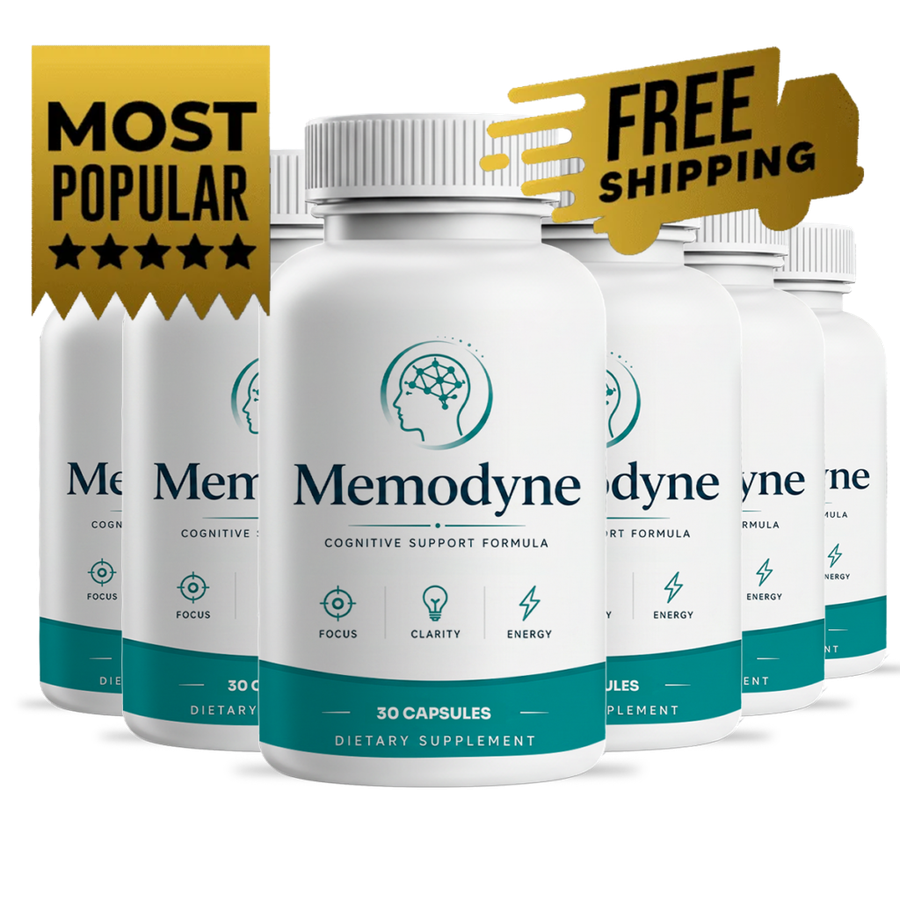
Multi-bottle pricing is where the discount sits: the per-bottle price falls from $69 on two bottles to $59 on three and $49 on six, with free US shipping on the larger two. Sales pages advertise savings of up to $780, calculated against a $179-per-bottle regular price nobody has paid. Current pricing is on the Memodyne official website.
Package pricing, shipping and the 60-day guarantee, verified 2026-08-14.
Check the current Memodyne sale price Compare packages
Redirects to the Memodyne official website. We may earn a commission at no additional cost to you. Pricing verified 2026-08-14 — confirm your total at checkout.